miércoles, septiembre 13, 2006
UC Santa Cruz or Bust
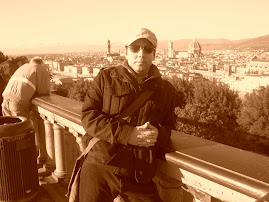
So the day has finally arrived when my little brother is leaving for college. Abrahamsterama is starting his freshman year at UC Santa Cruz (www.ucsc.edu) in Northern California. He is very excited about taking off to the next journey in his adult life. And everyone in our familia is equally ecstatic to see our baby brother make the leap from childhood to adulthood. We are especially proud that he will be venturing into an area that we know little about. Because that is what college and learning are all about, discovery on all levels, starting with geography. Mucha suerte to all you freshmen out there!


The Vaccine Controversy: Skipping Your Flu Shot
As many of you consider lining up and paying for a flue vaccine this season, you should strongly consider the risks associated with the whole concept of mass vaccination.
Below please find some information from Wikipedia on the Vaccine Controversy. Inform yourself, it's the least you can do before you pay the pharmaceutical companies to inject chemical concoctions into your body.
http://en.wikipedia.org/wiki/Vaccine_controversy
The vaccine controversy encompasses many issues over the benefits and risks of vaccines.
Vaccines are widely credited with reducing the prevalence and consequences of many diseases. National and international public health organizations have made vaccination a central part of their strategies. The consensus of health organizations and medical doctors is that mass vaccination campaigns have been an essential and effective component of eradication or control of several deadly diseases via individual and herd immunity.
Critics question the claimed efficacy and safety of such programs. The medical community, however, overwhelmingly supports vaccination as an effective and safe means of preventing the spread and reducing the impact of infectious illnesses. The majority of public health advocates holds the opinion that the benefit to the public justifies mandatory programs.
Research continues into both the development of new vaccines for a broadening array of diseases and the efficacy and safety of vaccines already in common use.
Criticism of widespread vaccine policy
The practice of vaccination has been opposed by some since its inception in the late 18th century, but criticism has become more visible in the US and some other developed countries in recent years, roughly paralleling the widespread availability of online information. While positions vary from outright rejection of the practice to calls for more selective and cautious use of vaccination, one or several of the following arguments are typically invoked:
Critics claim that the public health benefits of vaccinations are exaggerated. They further claim that the mortality rates of some illnesses were already dramatically reduced before vaccines were introduced, and claim that further reductions cannot immediately be attributed to vaccines.
Secondary and long-term effects on the immune system from introducing immunogens directly into the body are not fully understood.
The recommended vaccination schedule does not consider the cumulative effect of being exposed to multiple immunogens at the same time and at a young age.
At least some vaccine studies did not include such young children (e.g., 5 week old infants, 2 month old infants)[citation needed], yet vaccination schedules start with newborns. There can be a vast difference between the weight and all around development of a newborn baby versus a toddler, yet this is not accounted for.
Opponents of current vaccination policy question whether vaccinations actually create immunity against the targeted diseases, since some people who have been vaccinated still contracted the illness.
By not exposing children to common childhood illnesses, they may be more susceptible to diseases at a point when their immune system is weakened, e.g., at an old age or when sick for other reasons.
As is true with any medication, adverse events to the vaccine (even when rare) may be worse than the disease itself, and there are isolated reports of serious health damage and even death, within hours or a few days of vaccination. Although there are now various national databases where reported reactions can be recorded, anti-vacinationists claim that serious adverse events are grossly under-reported.
There are a number of possible conflicts of interest that may affect the research design, findings, and opinions about vaccines, including financial interests of companies, the self-regulatory mechanism of medical doctors, and fear of the consequences should vaccines be found to be dangerous (see 2000 Simpsonwood CDC conference for example of such fears). But there are also concerns that opponents of vaccines may be seeking to enrich themselves through litigation or the sale of alternatives, by spreading fear and misjudgment among the public.
Religious objections, by certain churches and by Christian Scientists to all forms of medical intervention.
The MMR controversy
Controversy has arisen regarding the safety of the MMR vaccine, because a handful of scientists and parents argue that the vaccine is the cause of the increased incidence of autism noted in western countries and Japan, and bowel disorders such as Crohn's disease. A theory advanced by proponents of the link is that the MMR vaccine overwhelms an immune system they assert is already struggling from the effect of thimerosal contained in previous vaccines. They assert that live measles virus in the formulation of the MMR is detrimental to susceptible individuals in a fashion in which wild measles never was.
During the 1980s and 1990s, a number of lawsuits were brought in the United States against manufacturers of vaccines, alleging the vaccines had caused a variety of physical and mental disorders in children. While these were inconclusive, they did lead to a massive jump in the costs of the MMR vaccine, as pharmaceutical companies sought to cover potential liabilities by lobbying for legislative protection. By 1993, Merck KGaA had become the only company willing to sell MMR vaccines in the United States and the United Kingdom. Two other MMR vaccines were withdrawn in the UK in 1992 on safety grounds arising from the strain of mumps component.
In September 1995, the Legal Aid Board in the UK granted a number of families financial assistance to pursue legal claims against the state health authorities and the vaccine's manufacturers, claiming that their children were killed or seriously injured by the MMR vaccine. A pressure group called JABS (Justice, Awareness, Basic Support) was established to represent families with children who, their parents said, were "vaccine-damaged."
In 1996, in New Zealand claims by an academic from Melbourne University that MMR contained a human blood product, serum albumin, and could therefore spread Creutzfeldt-Jakob disease caused anxiety.[citation needed] This did not last, since serum albumin was not an ingredient of the MMR vaccine.
Below please find some information from Wikipedia on the Vaccine Controversy. Inform yourself, it's the least you can do before you pay the pharmaceutical companies to inject chemical concoctions into your body.
http://en.wikipedia.org/wiki/Vaccine_controversy
The vaccine controversy encompasses many issues over the benefits and risks of vaccines.
Vaccines are widely credited with reducing the prevalence and consequences of many diseases. National and international public health organizations have made vaccination a central part of their strategies. The consensus of health organizations and medical doctors is that mass vaccination campaigns have been an essential and effective component of eradication or control of several deadly diseases via individual and herd immunity.
Critics question the claimed efficacy and safety of such programs. The medical community, however, overwhelmingly supports vaccination as an effective and safe means of preventing the spread and reducing the impact of infectious illnesses. The majority of public health advocates holds the opinion that the benefit to the public justifies mandatory programs.
Research continues into both the development of new vaccines for a broadening array of diseases and the efficacy and safety of vaccines already in common use.
Criticism of widespread vaccine policy
The practice of vaccination has been opposed by some since its inception in the late 18th century, but criticism has become more visible in the US and some other developed countries in recent years, roughly paralleling the widespread availability of online information. While positions vary from outright rejection of the practice to calls for more selective and cautious use of vaccination, one or several of the following arguments are typically invoked:
Critics claim that the public health benefits of vaccinations are exaggerated. They further claim that the mortality rates of some illnesses were already dramatically reduced before vaccines were introduced, and claim that further reductions cannot immediately be attributed to vaccines.
Secondary and long-term effects on the immune system from introducing immunogens directly into the body are not fully understood.
The recommended vaccination schedule does not consider the cumulative effect of being exposed to multiple immunogens at the same time and at a young age.
At least some vaccine studies did not include such young children (e.g., 5 week old infants, 2 month old infants)[citation needed], yet vaccination schedules start with newborns. There can be a vast difference between the weight and all around development of a newborn baby versus a toddler, yet this is not accounted for.
Opponents of current vaccination policy question whether vaccinations actually create immunity against the targeted diseases, since some people who have been vaccinated still contracted the illness.
By not exposing children to common childhood illnesses, they may be more susceptible to diseases at a point when their immune system is weakened, e.g., at an old age or when sick for other reasons.
As is true with any medication, adverse events to the vaccine (even when rare) may be worse than the disease itself, and there are isolated reports of serious health damage and even death, within hours or a few days of vaccination. Although there are now various national databases where reported reactions can be recorded, anti-vacinationists claim that serious adverse events are grossly under-reported.
There are a number of possible conflicts of interest that may affect the research design, findings, and opinions about vaccines, including financial interests of companies, the self-regulatory mechanism of medical doctors, and fear of the consequences should vaccines be found to be dangerous (see 2000 Simpsonwood CDC conference for example of such fears). But there are also concerns that opponents of vaccines may be seeking to enrich themselves through litigation or the sale of alternatives, by spreading fear and misjudgment among the public.
Religious objections, by certain churches and by Christian Scientists to all forms of medical intervention.
The MMR controversy
Controversy has arisen regarding the safety of the MMR vaccine, because a handful of scientists and parents argue that the vaccine is the cause of the increased incidence of autism noted in western countries and Japan, and bowel disorders such as Crohn's disease. A theory advanced by proponents of the link is that the MMR vaccine overwhelms an immune system they assert is already struggling from the effect of thimerosal contained in previous vaccines. They assert that live measles virus in the formulation of the MMR is detrimental to susceptible individuals in a fashion in which wild measles never was.
During the 1980s and 1990s, a number of lawsuits were brought in the United States against manufacturers of vaccines, alleging the vaccines had caused a variety of physical and mental disorders in children. While these were inconclusive, they did lead to a massive jump in the costs of the MMR vaccine, as pharmaceutical companies sought to cover potential liabilities by lobbying for legislative protection. By 1993, Merck KGaA had become the only company willing to sell MMR vaccines in the United States and the United Kingdom. Two other MMR vaccines were withdrawn in the UK in 1992 on safety grounds arising from the strain of mumps component.
In September 1995, the Legal Aid Board in the UK granted a number of families financial assistance to pursue legal claims against the state health authorities and the vaccine's manufacturers, claiming that their children were killed or seriously injured by the MMR vaccine. A pressure group called JABS (Justice, Awareness, Basic Support) was established to represent families with children who, their parents said, were "vaccine-damaged."
In 1996, in New Zealand claims by an academic from Melbourne University that MMR contained a human blood product, serum albumin, and could therefore spread Creutzfeldt-Jakob disease caused anxiety.[citation needed] This did not last, since serum albumin was not an ingredient of the MMR vaccine.
View of the East River - Puente
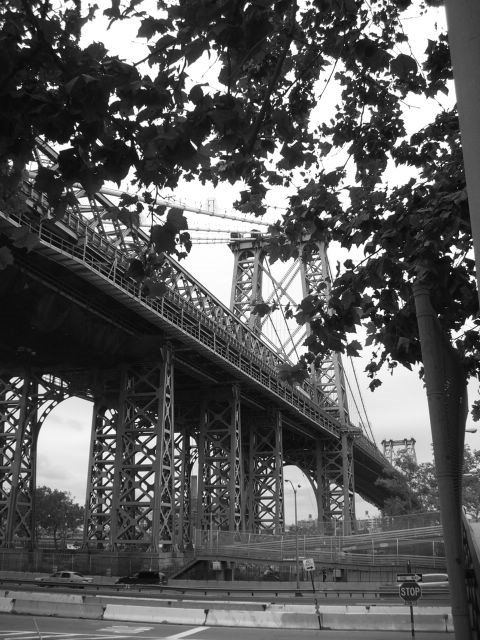
Siempre estoy impresionado por los puentes en ciudades grandes. En Nueva York, los puentes que conectan la isla de Manhattan con Brooklyn, Queens y Williamsburg son indispensables para el area metropolitana.

Arte Divino en los Altos del Lado de la Madrugada

San Juan el Divino, adjacent. When I studied at Columbia University, I always enjoyed passing by this sculpture in the garden immediately to the right of the St. John the Divine Cathedral. This is located on Amsterdam Avenue and 110th Street.
Shelled

Esta fotografia fue tomada en Manhattan durante el mes de Agosto del 2006. Es muy interesante conocer mas sobre la obsesion infantil con el pulpo, y la imagen de estos animales del mar.
viernes, septiembre 08, 2006
public living space

Some of the furniture at this sidewalk sale was actually not bad. I especially enjoyed the wall decorations, from big game heads reminiscent of the wild west to some zoroastrian figures. Of course, the Psychic Readings sign with no area code is classic. El Senor Josue took Tomas' lead and enjoyed the Soho street lounge.
SoHo Sidewalk Lounge

Later that day we ended up in SoHo, and somewhere on Houston we saw this large sidewalk sale with tons of comfortable furniture. Tomas quickly chose the gentlemen's chair. I kept on looking to see if a waitress could get us some cuba libres and mojitos.
Sandia en Harlem
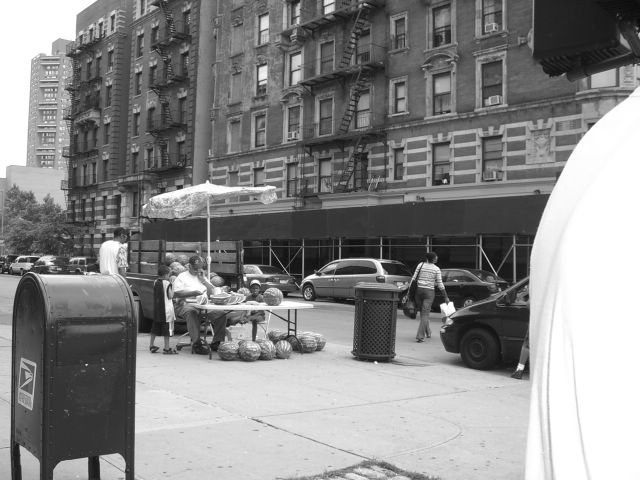
Okay, so I don't always follow my parents' advice that one should never show up emptyhanded when visiting friends and family. But during the July 4th weekend when I was in NYC, Tomas and I were walking towards Josue's apt in Harlem. As we walked past an old church, we each picked up some encyclopedia volumes that were being tossed out - no joke - someone was actually tossing out to the garbage an entire collection of encyclopedic knowledge. So I decided to take Josue volume B, a la Sesame Street, making our journey sponsored by the letter B. And then we saw this old man selling watermelons out of a truck from North Carolina. So that day, Josue got a nice big North Carolina watermelon, and a volume of the letter B. Only in NYC. July 3, 2006.
"Synth Happens" on the East River

During my most recent trip to Nueva York, Loida, Tomas, Josue and I worked our way to the Lower East Side to watch some of our friends perform at an outdoor concert by the East River Park Amphitheater. The band used to be called "Divorce" but recently changed their name to "Synth Happens." On the one hand, we all bought very cheap beer and drank them in brown paper bags, and on the other, we got to chill with the band and some of their friends after the show. The day was great, and I wish that my black and white obsession could have taken a back seat for the day so you could all see how nice and sunny it was. Well, there were some showers on and off. But it's Manhattan, so you easily forget about the rain.
una dozena de shakiras por favor

Estaba caminando por la calle 110 en Nueva York, en el vecindario de Morningside Heights justamente cuando se convierte oficialmente en Harlem. Fue durante esta caminata que voltea hacia Tomas, y vimos mase de una dozena de Shakiras chupandose el dedo, promoviendo su nuevo album Fijacion Oral No. 2. Decidi tomar esta fotografia de tantas Shakiras en plena calle de Nueva York durante el fin de semana de 4 de Julio.
Suscribirse a:
Entradas (Atom)